
What Gets Measured Matters: A UNESCO Policy Paper on Rethinking Assessment in ESD

In a new policy paper published by UNESCO, led by Daniel Fischer (Leuphana University Lüneburg) together with Jordan King (University of Tennessee at Chattanooga) and Aaron Redman (Arizona State University), we set out why Education for Sustainable Development (ESD) needs a different approach to assessment, what is currently going wrong and what curriculum, examination and school authorities can do to change that. The paper draws on the UNESCO project Transforming futures: Enhancing practice for ESD for 2030 through action research, including action research at 41 institutions in 10 countries.
The starting point is that assessment shapes what counts as learning. Where assessment centres on content recall and individual ranking, it pulls learners away from the competencies ESD seeks to develop, such as systems thinking, ethical decision-making and collaborative action. The paper describes three documented shortfalls: ESD assessment does not sufficiently meet learners' needs (including their well-being), it has seen too little methodological innovation, and it is too often disconnected from the participative, normative and integrative principles of ESD. A comparison table contrasts mainstream and ESD-aligned assessment along six policy-relevant dimensions, from the purpose of assessment to the roles of learners and educators and the evidence base.
| Dimension | Mainstream assessment practices | ESD-aligned assessment practices |
|---|---|---|
| Primary purpose(why the assessment is being conducted) | Ranking, grading and selection; certification at end of cycle. | Supporting learning; certifying real-world capability and disposition to act. |
| Object of assessment(what is being assessed) | Recall and application of codified subject content. | Cognitive, socio-emotional and behavioural learning, including values, judgement and action competence. |
| Methods(how it is assessed) | Timed written tests, multiple choice, essay; standardized at large scale. | Authentic tasks, project portfolios, peer- and self-assessment, performance and reflective evidence; mixed methods. |
| Roles(who has which roles in it) | Educator (or external body) assesses; learner is being assessed. | Learner is co-designer and co-assessor; teacher facilitates; community partners contribute evidence. |
| Alignment | Often loosely aligned with intended outcomes; taught curriculum and tested curriculum diverge. | Constructive alignment of outcomes, learning activities and assessment (Biggs, 1996); explicit fit with the participative, normative and integrative principles of ESD. |
| Evidence base | Strong on reliability and comparability; weaker on validity for complex, transferable competencies. | Stronger on ecological and consequential validity; reliability addressed through criteria, moderation and triangulation. |
Source: Based on Fischer, King & Redman, 2025. Reproduced from the policy paper (p. 4).
Two stories from the project show that change is feasible within existing systems: subject-embedded formative assessment at an upper secondary school in Slovenia, and a whole-institution model in Cuba, where ESD assessment is part of the school's operational plan. The recommendations are organised by the actors who hold the levers: policymakers and programme managers, curriculum developers, administrators and leaders, assessment specialists and examination authorities, and educators and learners themselves. The policy paper accompanies the UNESCO guidance tool Assessing learning in Education for Sustainable Development and its DARE process (Describe, Appraise, Redesign, Evaluate), which offers educators a structured cycle for redesigning their own assessment practice.
Paper Abstract:
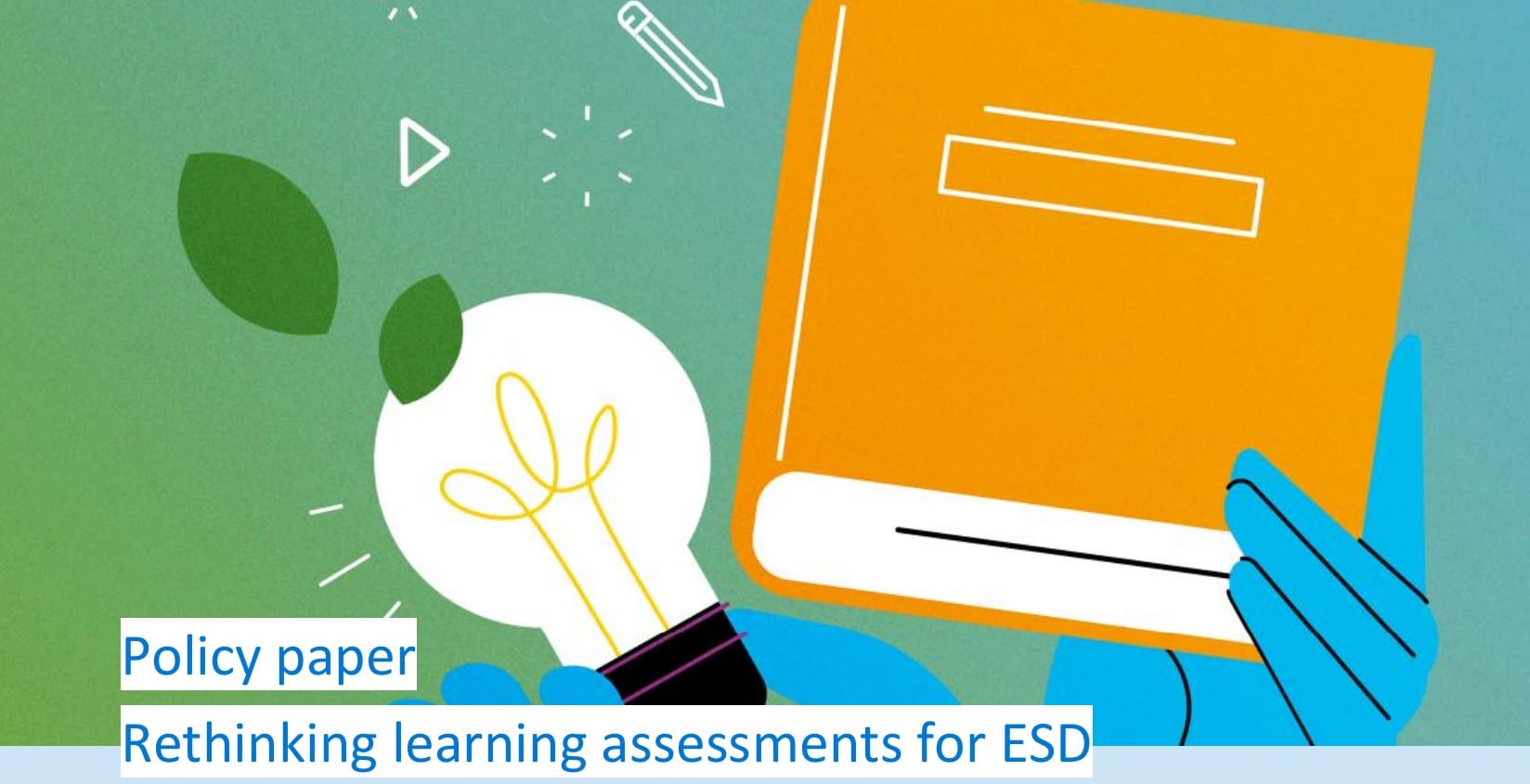
Assessment is critical to making Education for Sustainable Development (ESD) transformative, but traditional approaches often emphasize memorization, grading and competition rather than reflection, collaboration and real-world problem solving. This policy paper emphasizes the need to shift to innovative, participatory and well-being-centered assessment practices that better support sustainability competencies and sustainable futures.
Bibliographic reference:
Fischer, D., King, J., & Redman, A. (2026). Rethinking learning assessments for ESD: Policy paper. UNESCO. https://unesdoc.unesco.org/ark:/48223/pf0000399849