
UNESCO Chair Lecture: Seema Bali, Gregor Torkar and Zintle Songqwaru on Teacher Leadership
What do teachers need to act as co-designers of sustainability transformations? On World Teachers’ Day, 5 October 2026, speakers from India, Slovenia and South Africa discussed the role of teachers and teacher education in shaping the development agenda beyond 2030.
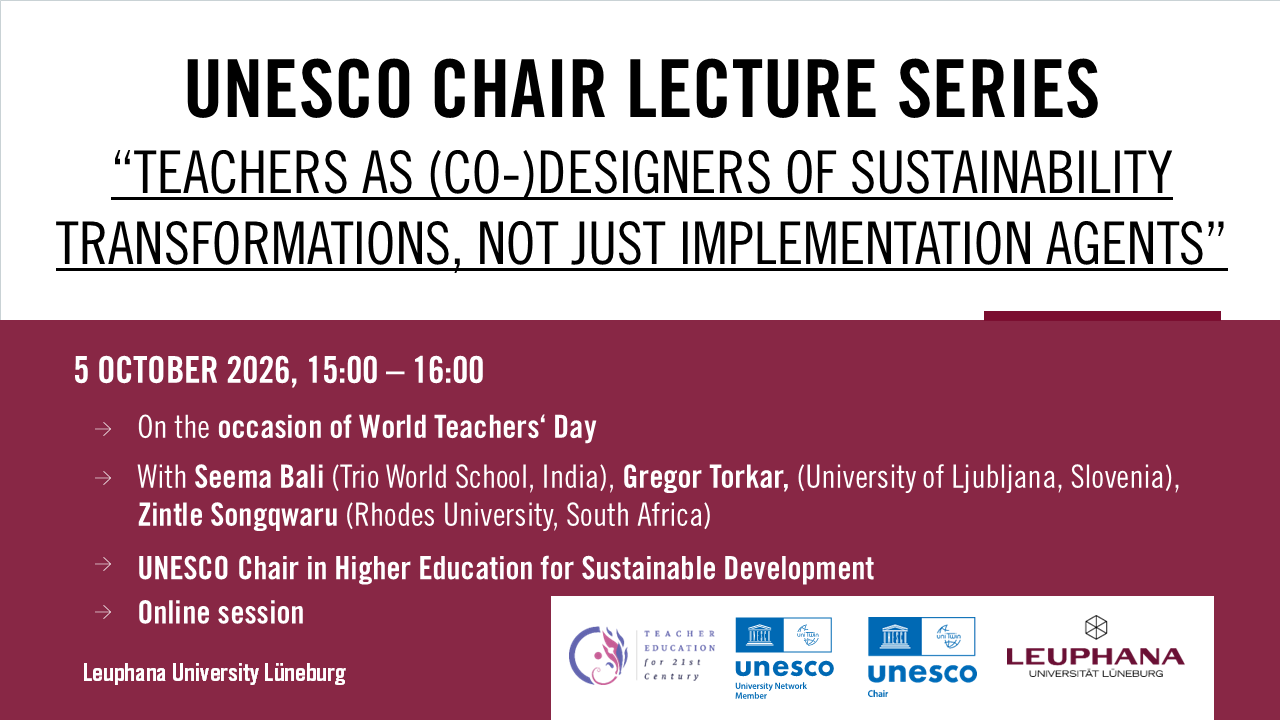
The 5th of October is commemorated internationally as World Teachers’ Day to “celebrate how teachers are transforming education, to reflect on the support they need to fully deploy their talent and vocation, and to rethink the way ahead for the profession globally” (UNESCO, 2026). While teachers play a critical role in fostering sustainability, a significant gap remains in creating the adequate support structures and enabling conditions they need to thrive in this role.
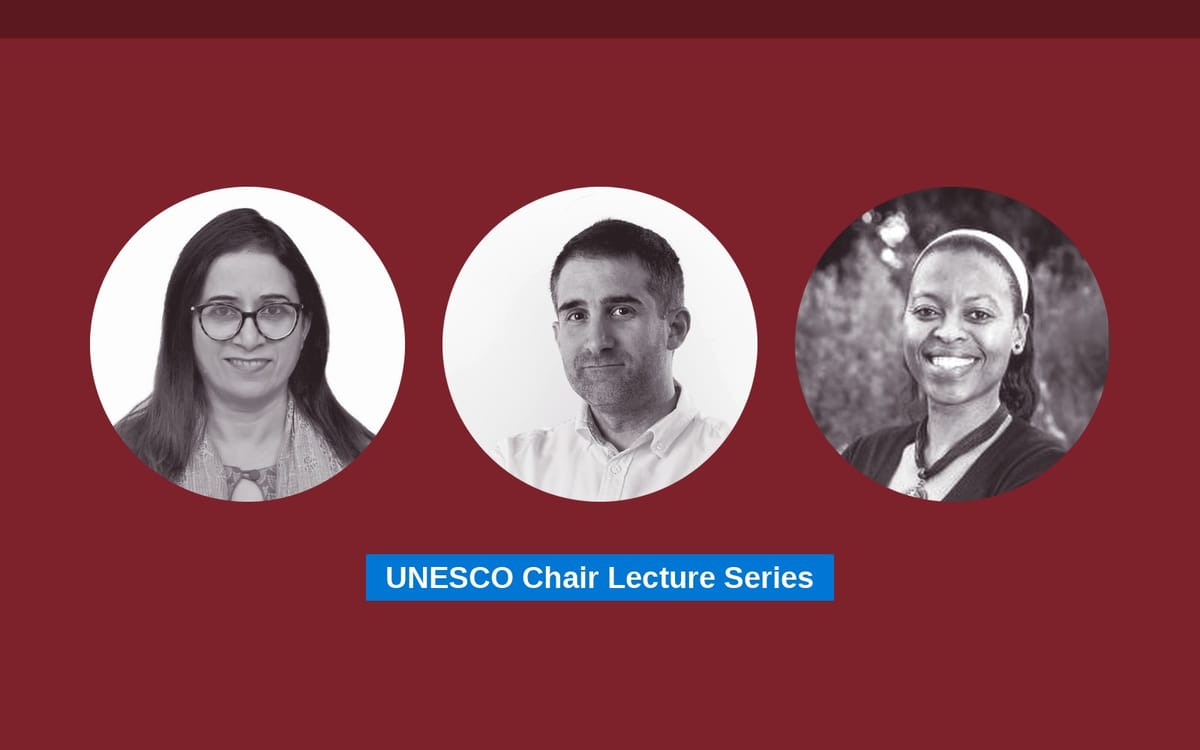
Taking a cue from the international theme of 2026 celebrations, we organised a dialogue between teachers and teacher educators. Seema Bali (Principal of the Trio World School, Bangalore, India), Gregor Torkar (Professor of Biology Education at the University of Ljubljana, Slovenia, and Chairholder of the UNESCO Chair on Teacher Education for Sustainable Development), and Zintle Songqwaru (Senior Lecturer and Researcher at Rhodes University, South Africa) explored the pivotal role of teachers and teacher training in shaping the global development agenda Beyond 2030, as well as challenges along the way. Carla Sabbatini (Universidad de San Andrés, Argentina), who had also been announced as a speaker, unfortunately had to cancel at short notice.
We are happy to share the recording of the session, which you can watch below or via this link.
About speakers
Seema Bali (Trio World School, India) is an accomplished education leader and Principal of Trio World School, Bengaluru, where she promotes innovative, student-centered learning and fosters a culture of leadership. As a Global Climate Leader with The Climate Reality Project, India, a public health advocate, and a member of the NCD Alliance’s Global Advisory Committee, she advances initiatives at the intersection of education, climate, and health. Through her work, she empowers teachers and students to become advocates and agents of change, promoting sustainability, climate action, transformative learning, meaningful participation, and youth-led solutions
Gregor Torkar (University of Ljubljana, Slovenia) is Full Professor of Biology Education at the University of Ljubljana and Chairholder of the UNESCO Chair on Teacher Education for Sustainable Development. His professional work focuses on science and biology education, environmental education and education for sustainable development, teacher education, sustainability competencies, and outdoor learning.
Zintle Songqwaru (Rhodes University, South Africa) is a senior lecturer at the Education Faculty in the Secondary and Post School Department, Rhodes University, South Africa. She has more than 12 years experience in teacher education, working with both pre- and in-service teachers. She has been involved in the South African national Teacher Education programme and projects like Fundisa for Change, the SADC Sustainability Starts with Teachers programme, and The Sub-Saharan Africa Teacher Leadership for Education for Sustainable Development. Zintle’s research interest is on ESD, programme evaluation, curriculum studies, community engagement in Teacher Education and ESD leadership. From August 2026, Zintle is a TWAS-DFG fellow at Leuphana University.
About the UNESCO Chair Lecture Series
The UNESCO Chair Lecture Series, hosted by the UNESCO Chair in Higher Education for Sustainable Development at Leuphana University Lüneburg, builds on and continues the legacy of earlier dialogue formats at our department, including the Institute for Sustainable Development and Learning’s series “In Conversation with …” and the UNESCO Chair’s “Rethinking Higher Education” series.
In this series, we bring together scholars from around the world to share their research and diverse perspectives on sustainability and Education for Sustainable Development (ESD). Designed as a hybrid format, the lectures offer a space for dialogue, exchange of ideas, and critical reflection on the role of higher education in shaping sustainable futures.
Should you have any further questions, please use our contact form